
How to Choose Football (Soccer) Team Uniforms
In this article
A good kit makes a team look organised and lets players move freely in all weather. Whether you run a grassroots club, a school team or an academy, these are the decisions that matter most.
1. What does a football uniform include?
- Shirt (jersey) — with crest, sponsor, number and optional name.
- Shorts — often with a number on the leg.
- Socks — matching or contrasting colour.
- Goalkeeper kit — a different colour from both teams, often with long sleeves and padded options.
- Extras — training tops, tracksuits, warm-up jackets and bags.
2. Fabric: light, breathable and quick-drying
Modern match shirts are almost always polyester knits. Look for:
- Moisture-wicking performance fabric that dries quickly.
- Mesh or vented panels under the arms and on the back for airflow.
- A weight that suits your climate — lighter fabrics for hot countries, slightly heavier or long-sleeve options for winter leagues.
- Flatlock or smooth seams to reduce rubbing.
3. Sublimated or printed?
| Full sublimation | Stock kit + heat-press / screen print | |
|---|---|---|
| Design freedom | Unlimited colours, patterns, gradients | Limited to the base garment colours |
| Durability of print | Ink is inside the fibre — won’t crack or peel | Good, but numbers can wear over many washes |
| Minimum order | Usually a team-sized MOQ per design | Can be very small |
| Lead time | Needs artwork approval and production | Often quicker |
For a unique club identity, sublimation is the usual choice. For a quick replacement of a few shirts, a printed stock kit can be simpler.
4. Check competition rules first
Leagues and associations often have rules on kit colours (home and away must contrast with opponents and referees), shirt and short numbering, captain armbands and sponsor size. Read your competition’s handbook before you finalise a design.
5. Get sizes right
- Share the manufacturer’s size chart with players or parents.
- Collect sizes, names and numbers in one spreadsheet.
- Order a small percentage of spare shirts for new players.
- For youth teams, consider ordering one size up for growth.
6. Plan the timeline
Work backwards from your first match: design and artwork approval, sample (if ordering for the first time), production, then shipping. Starting early avoids paying for express freight.
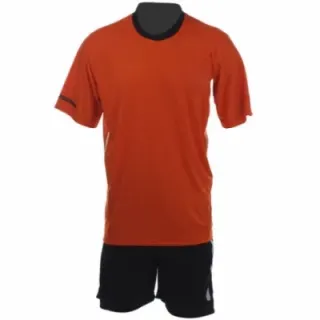 Soccer UniformsPerformance Soccer Uniform
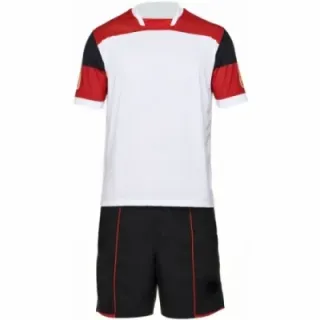 Soccer UniformsPremium Soccer Uniform
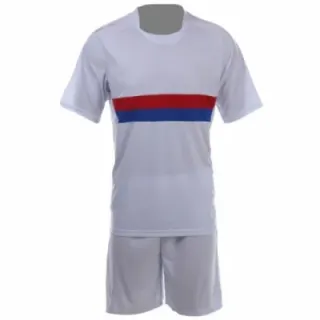 Soccer UniformsMatch Day Soccer Uniform
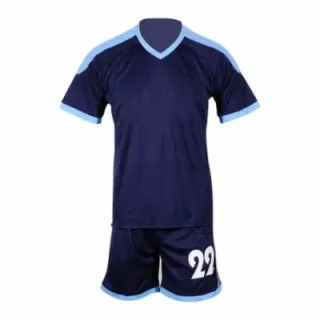 Soccer UniformsPremium Soccer Uniform
Design your kit
You can try colours, patterns, your crest, names and numbers in our online 3D designer, then send the design to us for a team quote.
Frequently asked questions
What is the best fabric for football shirts?
Lightweight, moisture-wicking polyester knit, often with mesh panels for ventilation. It dries quickly and is suitable for sublimated designs.
Can each player have their own name and number?
Yes. Names and numbers can be sublimated or heat-applied individually — provide a list of names, numbers and sizes when you order.
Do goalkeepers need a different kit?
Yes. Most competitions require the goalkeeper to wear colours that distinguish them from both teams and the referee.
Products related to this guide
Kitting out a gym, club or team?
We produce custom team and gym apparel in bulk — your colours, logo and names. Design it in 3D or send us your requirements.